IN CONVERSATION WITH RHYS COREN
ON PERMANENCE, MATERIAL AND MAKING AT ARCHITECTURAL SCALE
For British artist Rhys Coren, Everyone I’ve Ever Known marked a shift in scale.
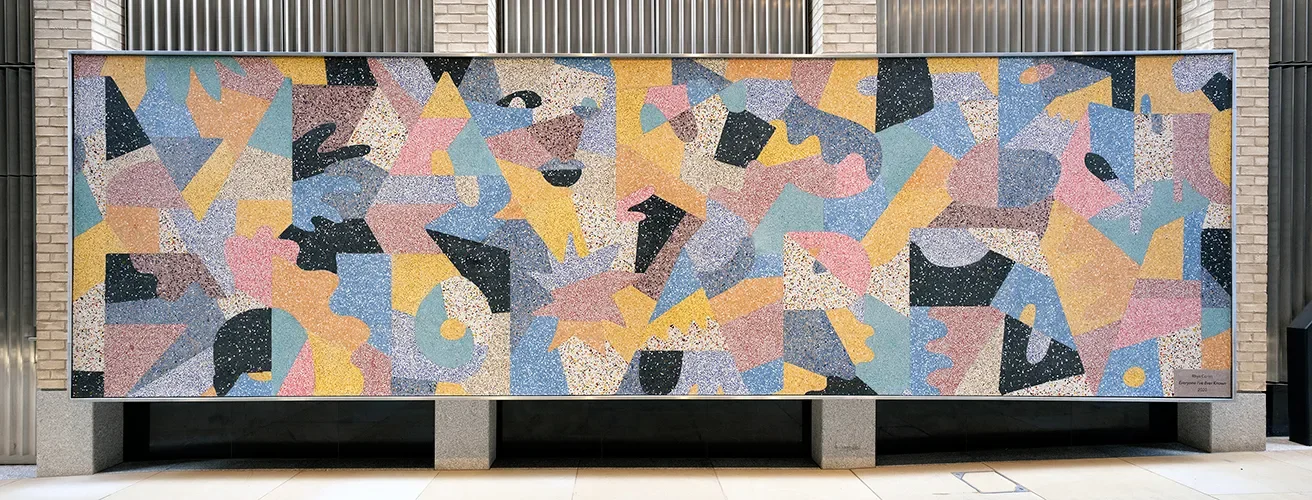
Created for Hanover Square in London, the nine-metre-long terrazzo artwork began with the language of Coren’s studio practice, drawing, colour, rhythm and composition, before being translated into hundreds of individually cut pieces and assembled as a permanent architectural work.
The project brought together ideas that have long run through Coren’s practice: the relationship between music and movement, the way colour can be constructed from smaller elements, and the transformation of a loose hand-drawn line into something precisely made. But working at this scale also introduced something else: permanence, architecture and the involvement of a much wider group of people in the process of making.
Southside Waterjet worked with Coren on the specialist fabrication of Everyone I’ve Ever Known, beginning a collaboration that has since developed through further public artworks and into furniture.
We spoke to Rhys about where Everyone I’ve Ever Known began, the influence of music and material on his work, what happens when a drawing becomes architecture, and how working with fabricators can become part of the creative process itself.
On permanence and scale
Everyone I’ve Ever Known was your first large-scale permanent public artwork. Where did the idea for the piece begin?
A couple of years before Everyone I’ve Ever Known, I’d made a commission for the Royal Academy Courtyard. It was enormous in scale, taking over the whole courtyard, but it was essentially made from light and sound. It was turned on every night and then, with the click of a button, the whole thing disappeared and the courtyard returned to normal. So I got to try working at that kind of scale without the pressure of permanence.
A few years before that I’d also been to Marfa in Texas, to the Chinati and Judd Foundations, and had seen permanently installed works there. Seeing those works as part of the wider chronology of Donald Judd’s practice, alongside his design work and exhibitions, made the idea of permanence feel slightly less daunting. It could just be another chapter within a practice.
“It could just be another chapter within the a practice”
The Bond Street commission started with a conversation about making three smaller light boxes, I assume because of what I’d done at the RA. Around the same time I’d been making small paintings that were essentially proposals for stained-glass windows. I didn’t know how to make stained glass, so I was almost trying to lure somebody into asking me to make one by making paintings that looked like them.
As the commission developed, the people involved encouraged me to think much bigger. I was used to thinking at the scale of a painting, almost a small television in your room in the 90s kind of size, whereas they were thinking at the scale of entire buildings and developments.
I started going back through old sketchbooks and found photographs I’d taken of floors in Venice, particularly around the Giardini and Arsenale. When I look at stained glass I think about someone sliding a disco dance floor onto a wall. I had the same thought looking at the terrazzo floors.
We developed the colours from scratch with terrazzo specialists, and the aggregate within the material mirrored something I was already doing in my paintings, where a turquoise section, for example, might actually be made from lots of tiny blue and green glass, almost like the dots in a comic. With terrazzo, you could get close and see all those individual pieces of coloured glass and stone that collectively made a single colour. So it was really all of those things coming together in a sort of perfect storm.
The title Everyone I’ve Ever Known came from a song. What was it about that phrase that seemed to belong to the work?
Even though I’d become slightly less daunted by the idea of making something permanent, deep down I probably still was. Everything about the work felt enormous and slightly all-or-nothing. It felt very EVERYTHING.
When you get close to the finished piece, there are hundreds of individual cut sections of terrazzo, and within each of those you can see all these tiny pieces of coloured glass and stone. There’s something almost cosmic about it. They started to feel like little galaxies or worlds within this much bigger thing.
I was thinking about the all-encompassing nature of it, and about everything I’d ever done somehow leading towards this particular moment. I’d actually written the word “everything” down while trying to find a title.
Then I was listening to New Order’s Regret, without consciously looking for a title, and the phrase “everyone I’ve ever known” suddenly stuck. It seemed to contain that same sense of something impossibly large and all-encompassing, while also being very personal. It just belonged to the work.
On music, movement and colour
Music seems to run through your practice, through rhythm, repetition, movement and even colour. Is there a relationship between the way you experience music and the way you compose an image?
Music has played lots of different roles in the work. At first it was fuel for it. I became interested in being on a dance floor and being part of this shared cultural experience, having this involuntary bodily reaction alongside all these other people. Everyone is moving together, but they're still sovereign individuals having their own experience.
There was something almost spell-like about the fact that these completely abstract forms in music could produce such a powerful physical and emotional response. I wanted to understand that better and somehow make images that could do something similar.
I think about chords almost like colours too. There are these basic building blocks and then all these tonal variations — sharps, flats, minors, different combinations. And the whole time you have this bodily confirmation when something sounds right.
“I think about chords almost like colours too”
So music has been fuel, inspiration and something I've represented directly, but more broadly it's also become a way for me to get better at making art by learning something that isn't art.
On material and surface
You’ve talked about shiny materials as almost repelling you, whereas matt surfaces absorb and draw you in. How does that thinking influence the materials and finishes you choose, and did it play a part in Everyone I’ve Ever Known?
I think surface has always been incredibly important to me. I tend to prefer surfaces that absorb you rather than bounce you back out again. With something highly polished or reflective, you're immediately conscious of the surface itself and often of your own reflection. A matt surface allows you to look into it.
Terrazzo was interesting because it could do both things in a slightly different way. From a distance the colours read as these big, flat graphic areas, but when you get close the surface breaks apart into all the individual pieces of aggregate, glass and stone.
It also changes according to its conditions. It looks different when it's wet, in daylight, or on a dark winter evening when the architectural lighting hits it. On those wet winter nights it almost glows. I really like that the material remains the same while the environment continually changes the way you experience it.
Do you see material simply as the means of making an artwork, or can the material itself become part of what the work is saying?
Material absolutely becomes part of what the work is saying, although I don't necessarily begin with a symbolic meaning for a material.
With Everyone I’ve Ever Known, terrazzo solved a practical problem because it was robust enough for permanent public work, but aesthetically it also echoed the way I'd already been making paintings. A single area of colour is actually made from lots of smaller colours and materials. You can experience it as one thing from a distance and then discover that it's made from hundreds of other things when you get close.
There's also something I like about stone existing on a different timescale from us. The work is permanent, but the world around it keeps changing. The light changes, the seasons change, it gets wet, people move past it at different speeds. The material gives you something relatively fixed against which all that movement can happen.
Also there’s the geological history of stone. If a few billion years of earth crust formation and squished dinosaurs can’t add some ‘content’, what can?
On drawing to fabrication
There’s something quite beautiful about a loose, hand-drawn line eventually becoming a series of precisely cut pieces of stone. How important was it that the fabricated work retained the character and movement of the original drawing?
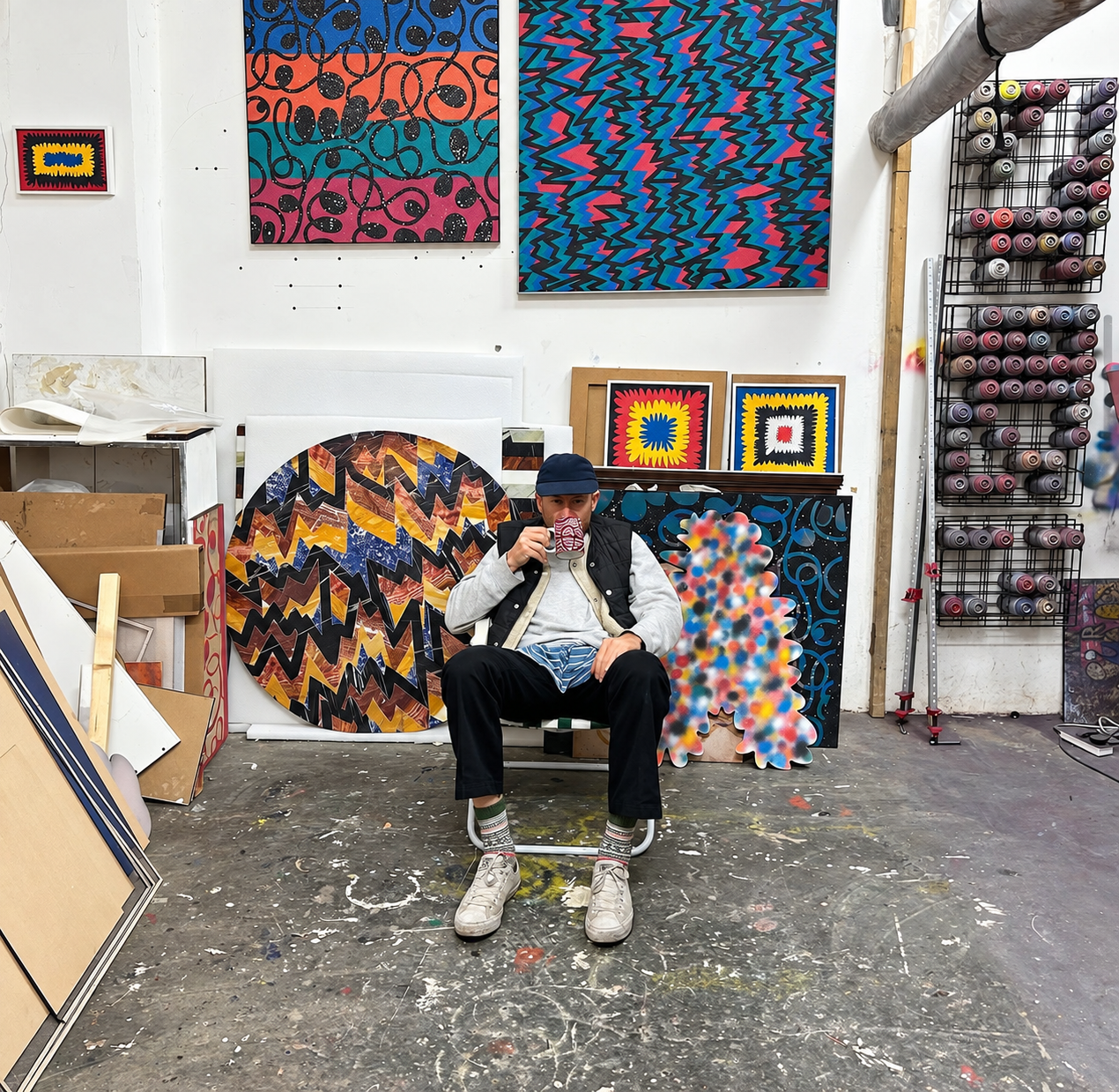
Very important. My studio paintings were already made through a slightly absurd process of translation. I'd make drawings on paper, scan them, digitise them, print them, collage and colour them, scan them again, trace them and then have all the individual components cut from MDF. The composition effectively became a giant jigsaw puzzle. I'd texture and pigment every individual component before assembling everything back together on one flat plane.
So the movement from a loose drawing into something incredibly precisely fabricated wasn't actually alien to the studio practice. It was already embedded in the way I worked.
The danger is that every stage of digitising, cutting and fabricating can gradually iron out the awkwardness or character of the original mark. I didn't want the technology to “improve” the drawing. The precision needed to be in service of retaining that movement rather than correcting it.
Your studio process often involves breaking an image down into individual components and then bringing those elements back together. With Everyone I’ve Ever Known, that happened on a completely different scale. What was it like seeing that process happen physically?
There was something strangely familiar about it because, again, that's essentially how I'd already been making paintings. The paintings were constructed from separate pieces that were individually worked on and then brought together.
The difference was that suddenly this process I'd been doing at studio scale was happening with specialist fabricators, enormous pieces of material and architectural tolerances.
There's something I find interesting about that leap in scale because whenever I finally see something I've made, however unfamiliar the process has been, the finished thing often feels strangely familiar. Even if it has come from almost nothing, I tend to look at it and think, “Oh yeah, that's what that was supposed to look like.”
Years later I can analyse the decisions and make them sound logical, but at the time you're often working much more through gut and intuition. Looking back, I'm sometimes amazed by the delta between what I actually knew at the time and what we managed to achieve.
On collaboration and making
When an artwork reaches this scale, other people inevitably become part of making it. How do you approach that relationship between artist and fabricator? Can working out how something is made become part of the creative process itself?
I really enjoy it. A studio practice can be incredibly solitary. You're in a room by yourself, or inside your own head, conceiving things according to your own set of rules. You put the work into a gallery and you're communicating with people, but you're generally not actually there when that communication happens.
Public work completely changes that. There are suddenly all these other voices involved.
Some artists might find other people's input distracting or intrusive, but I actually thrive off it. Ultimately nobody is going to make me do something I don't believe results in a good artwork, so I'm not particularly frightened of other people's opinions. Having voices other than my own interrupting the monologue is healthy.
David Farries at GPE and Jes Fernie, the curator, were incredibly ambitious for the Bond Street work. Their encouragement was a major part of it becoming a single nine-metre piece rather than the smaller works I'd initially imagined. The architects were pushing things too.
Then there was Pete and Southside. They were originally brought in essentially to cut the work, but it gradually became apparent that they were capable of much more than that. Nothing seemed to faze them. We realised they could effectively project-manage a lot of the fabrication, and in retrospect their input would have been useful even earlier in the process.
Restrictions can actually generate better creativity. Somebody telling you what can't be done, or suggesting that something could be much more ambitious than you'd imagined, gives you something to push against.
You and Pete have worked together on a number of things now. Has that ongoing relationship with a fabricator changed what you feel is possible when you're developing an idea?
Completely. Everyone I’ve Ever Known was really the beginning of that relationship.
The important thing about working repeatedly with somebody like Pete is that you develop a shared language. You know what each other is capable of and, perhaps more importantly, you stop dismissing ideas before you've even discussed them.
That relationship continued into the much larger Bishopsgate project and has now also developed into us making furniture together, too. There's a freedom that comes from being able to have an idea and take it to somebody whose immediate response isn't to be fazed by how difficult it might be.
Having Pete on board from the very day I was approached about the Bishopsgate piece meant I could go into the initial proposal stage with a design that far exceeded the expectations of the client. Pete's knowledge of both the materials and how I work meant he was able to nudge me in a more ambitious direction.
It changes the point at which fabrication enters the creative process. It isn't simply, “Here's my finished drawing, please make it.” The conversation about how something might physically exist can start becoming part of developing the idea itself.
I enjoy responding to Pete’s ideas.
On what came next
Do you remember the first time you saw Everyone I’ve Ever Known completely assembled? Was it different from how you had imagined it when it existed as a drawing?
The funny thing is that whenever I finish something, like I said before, it tends to feel familiar.
There's obviously an enormous gap between a drawing and a nine-metre terrazzo work, and particularly with something like this there were so many stages at which I couldn't completely know what the finished thing would feel like.
But when I finally see a work, even if it's effectively been birthed from nothing, I tend to have this feeling of, “Oh yeah. That's what that was supposed to look like.”
Looking back years later, I sometimes get little shivers because I think about the gap between what I knew then and what I somehow managed to achieve. In retrospect I can analyse it and construct a rationale around all the decisions, but at the time so much of it was gut and intuition.
I'm occasionally slightly horrified by the mistakes I could have made or narrowly avoided, but perhaps that's part of what makes those leaps exciting.
You’re now working at an even greater architectural scale with the public artwork at One Exchange Square. Has making Everyone I’ve Ever Known influenced the way you approach public work now?
Massively. Everyone I’ve Ever Known taught me that I could work at an architectural scale without losing the things that mattered in the studio work. It also taught me that collaboration doesn't have to dilute an idea. It can make the work considerably more ambitious.
“Collaboration doesn’t have to dilute an idea. it can make the work considerably more ambitious”
The One Exchange Square work is around sixty metres long and made from reclaimed granite, so the scale and complexity are much greater again. But I don't think I could have approached something like that in the same way without having made Bond Street first.
Funnily enough, it was Pete working on Everyone I’ve Ever Known on the floor, allowing us to walk on it, that made me want to slide the Bishopsgate work back off the wall and put it in the ground.
Bond Street also changed my understanding of audience. In a gallery, somebody has made a conscious decision to come and look at art. With public work, you can catch somebody who is simply walking to work, shopping, going home or passing through. You can think about the direction they're approaching from, the speed they're moving at, what they see from a distance and what gradually unfolds as they get closer.
I like that enormously. With Bond Street I wanted something big, colourful and punchy enough to catch someone's attention from the end of the street, but detailed enough that somebody walking past twice a day might still notice something new months or years later.
You can very subtly alter somebody's rhythm through a space, or just distract them for a few seconds and hopefully make that part of their day slightly brighter.
Looking forward
And finally, what are you working on at the moment, and is there anything coming up that we should be looking out for?
We've essentially finished making the One Exchange Square work at Bishopsgate and we're waiting for the final stages of installation and for the site to properly open. It's a roughly sixty-metre-long floor work made from reclaimed granite, so that's obviously been an enormous project.
Pete and I have also been developing furniture together, which has been slightly on hold while the public project was taking up so much time, so I'm looking forward to getting back into that collaboration.
I've recently completed a large commission for a children's mental-health hospital, where I worked with the children there. That's fed back into my studio practice in ways I wasn't necessarily expecting. I've become much more interested again in collage, paper and more modest materials.
For a long time I was quite guilty of compartmentalising different parts of my practice. Painting was painting, animation was animation, works on paper were something else, and I worried about them corrupting each other if I put them too close together.
Recently the gloves have come off a bit. I'm much more interested in smooshing all of it together and allowing one way of working to contaminate another.
I just had a show in Berlin, I’ve got a show in Margate at the moment, and I've recently opened a show in New York. I'm generally exploring a whole new way of working in the studio. That's probably the thing I'm most excited about at the moment.
EVERYONE I’VE EVER KNOWN
Discover the making of Rhys Coren’s nine-metre terrazzo artwork, from the original drawing through precision fabrication and assembly.
EXPLORE THE PROJECT →