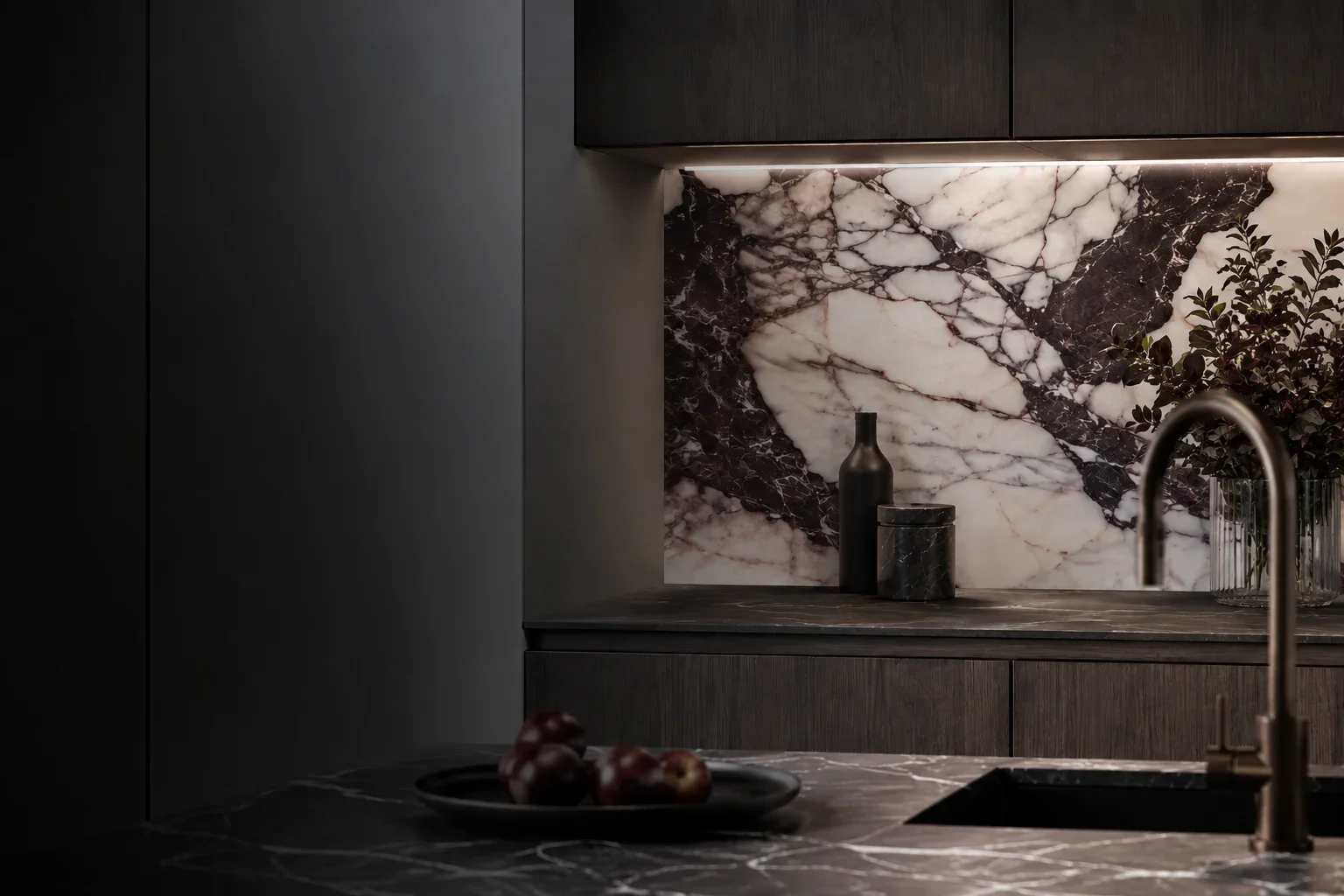
ON CHRONOS, MATERIAL, MAKING AND ART AT ARCHITECTURAL SCALE
Following the completion of CHRONOS at Fresh Wharf, we spoke with British artist George Henry Longly about the ideas behind the work, his relationship with material and the process of translating an artwork from concept to architectural scale.
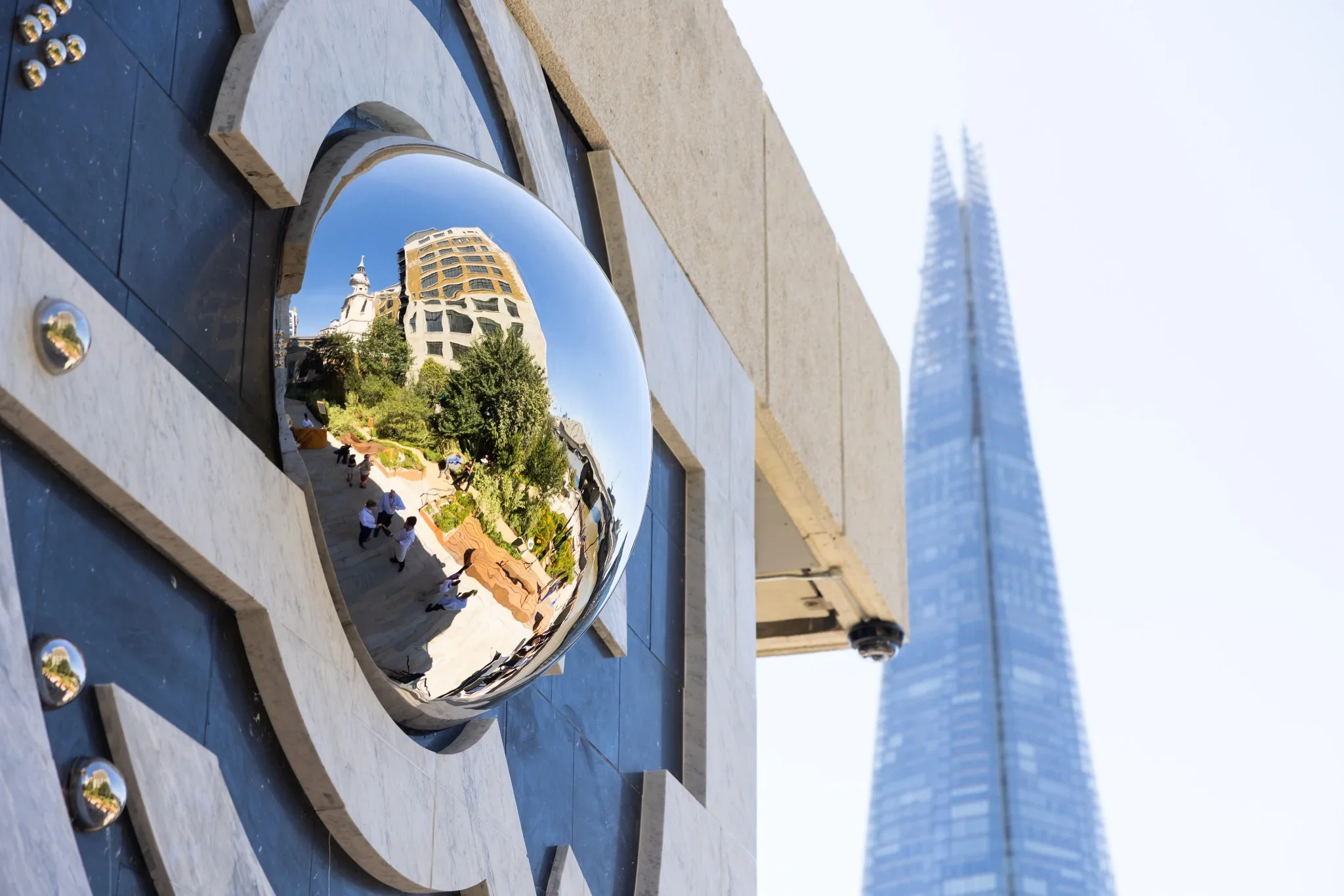
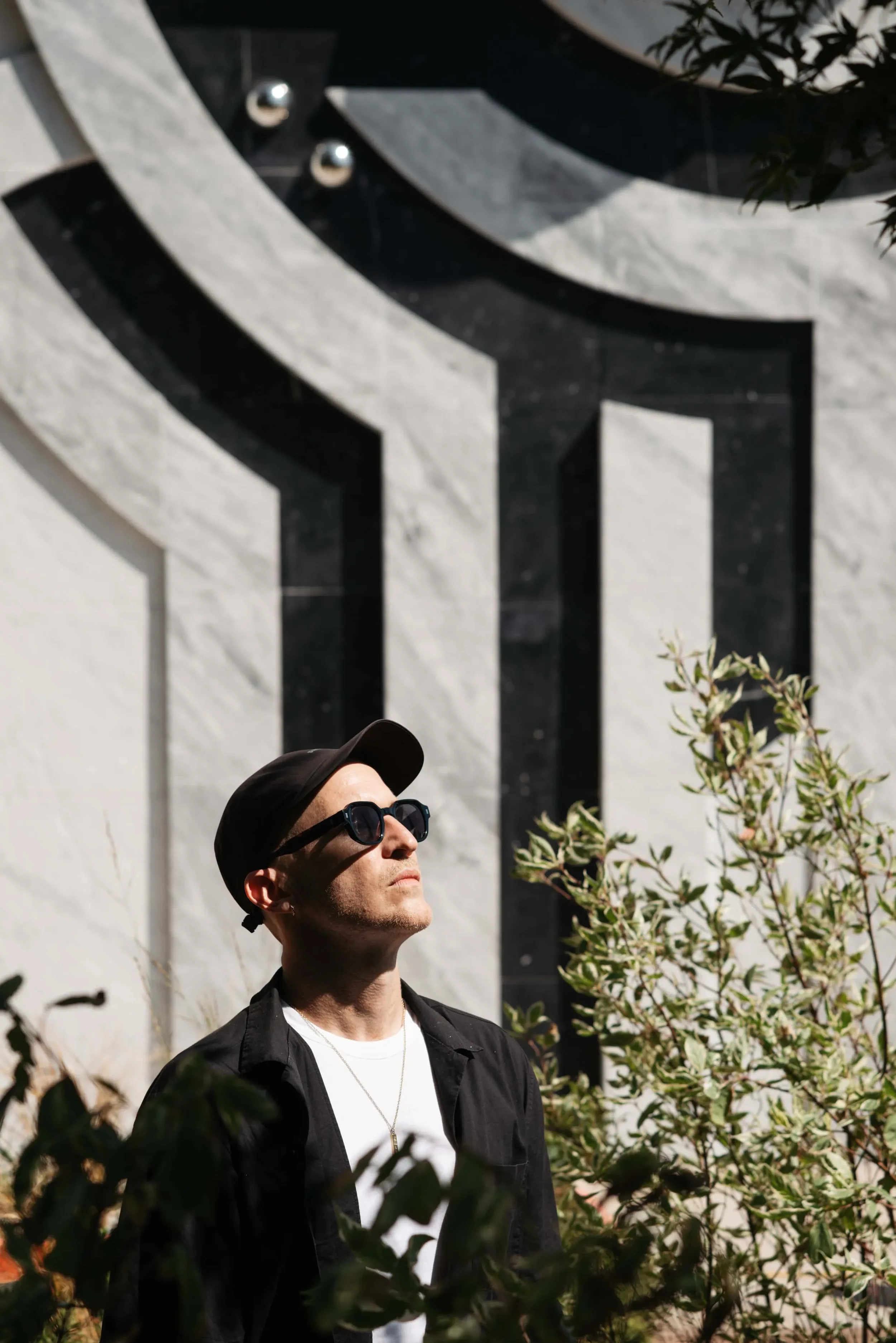
Installed on the riverside façade of Fresh Wharf in London, CHRONOS brings together stone, marble, brass and polished stainless steel in a permanent public artwork that responds to ideas of time, geology, mythology and place.
Having fabricated the stone elements for the installation, we wanted to hear the story from the other side of the process — from the artist who conceived it.
Where did the idea for CHRONOS begin, and what was it about the Fresh Wharf site that particularly interested you?
The work really began with the site. I was interested in its position on the Thames and in the accumulation of history beneath the ground. Fresh Wharf is the site of a Roman wharf and sits close to the old London Bridge, in an area that has been continuously occupied and transformed for almost two thousand years. But the history of this part of London extends much further back, with traces of Neolithic and Bronze Age activity alongside its Roman, medieval and modern histories.
I also looked to the history of public art in London, particularly artists such as Eduardo Paolozzi, Henry Moore, Barbara Hepworth, William Mitchell and Veronica Ryan. The building itself became an important reference. Its post-war modernist architecture represents a period in Britain when ambitious art, architecture and design were often conceived in close relationship to one another. Building work on Magnus House began in 1978, the year I was born, so there is also a nice cyclical element to my relationship with the site.
I began thinking about the site almost as a geological section, with layers of human activity, architecture and material accumulating over time. That feels very particular to London, where architectural styles, forms and fragments from radically different periods coexist, sometimes within a single building or streetscape. So the starting point for CHRONOS was almost archaeological: a deep dive into the site through time, looking at what had accumulated there and how those different histories might be brought together within a single work.
The work explores ideas around time, geology, mythology and the history of its location. How did those different influences begin to shape the final composition?
I didn’t want the work to illustrate the history of the site literally. Instead, I began collecting forms and references from very different scales of time: geological structures, fossils and marine organisms alongside archaeological fragments, architectural forms, constellations, circuits and systems, and mythology. Gradually, these different references began to form a shared visual language. The composition itself became central to the work, balancing and bringing these disparate elements together into an arrangement that creates a kind of logic of its own.
The title CHRONOS relates to time, but also to the way we try to measure and understand something that is ultimately much larger than us. Mythology became another way of thinking about this. The Romans who occupied this part of London brought with them gods and belief systems with origins stretching much further back in time.
The nearby Temple of Mithras became an important reference, particularly because Mithraism has often been associated with celestial imagery, constellations and ideas around cosmic time. Stars and constellations appear within the work partly for this reason. Looking up at the stars is also something that connects our relatively short lives with those who came before us — people thousands of years ago looked at essentially the same night sky, set against a scale of time that is almost impossible for us to comprehend. The stars have also been a source of gods, myths and belief systems throughout human history.
The composition developed almost like a collision of different temporal systems: deep geological time, biological time, human history, and the much faster cycles through which cities are built, demolished and rebuilt. I wanted all of these scales of time to coexist without any one of them necessarily taking precedence. The mirrored spheres bring another layer into this: they reflect the architecture, the surrounding city and the people moving through the space, continually bringing the present moment into a work concerned with the histories embedded in the site and with much larger scales of time.
Stone, marble, brass and polished stainless steel have very different qualities. What drew you to that combination of materials?
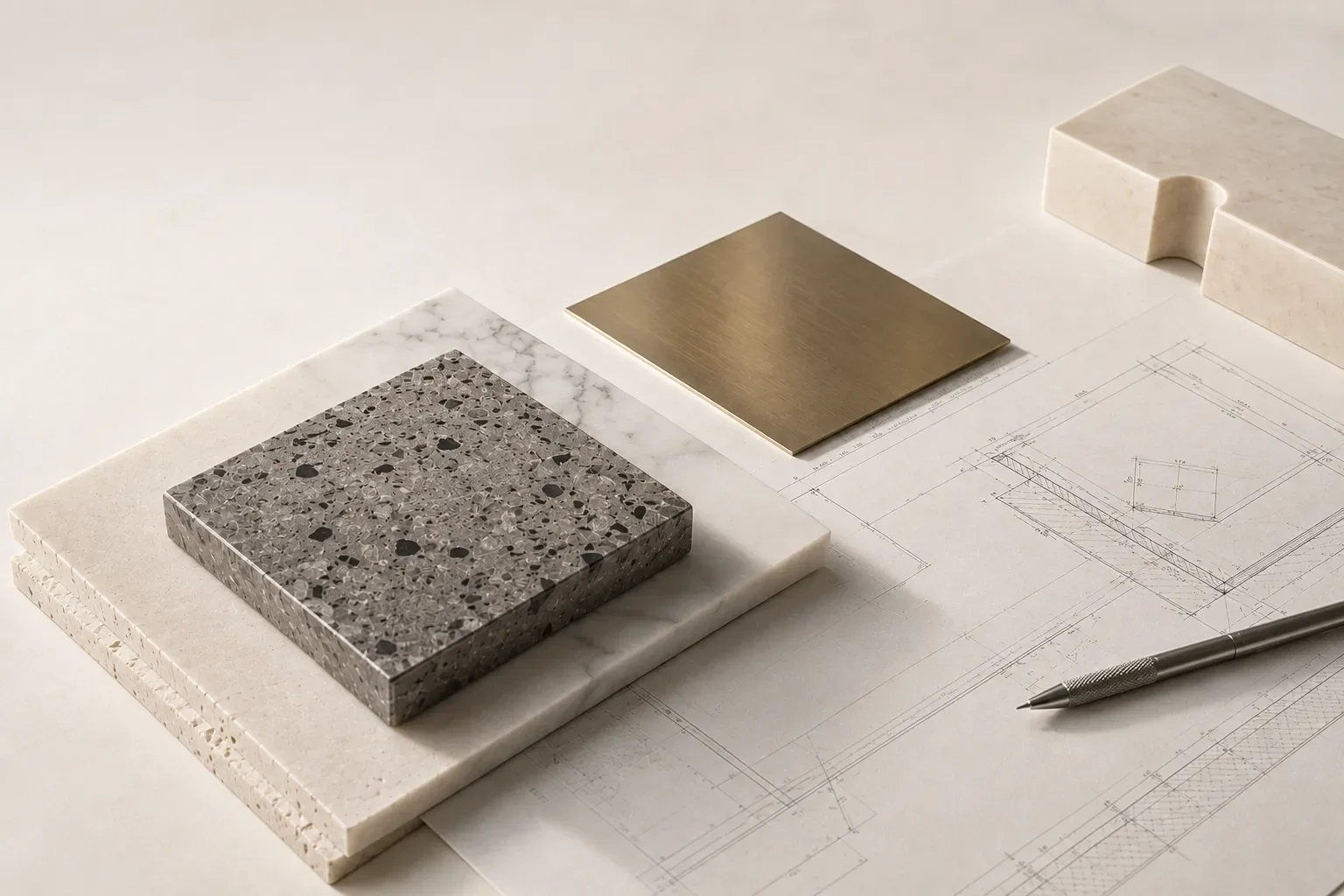
I was interested in materials that carry very different associations with time. Stone and marble immediately connect us to geology, architecture, monuments and archaeology. Brass has a warmth and a historical quality, and it changes subtly as it ages. The polished stainless steel does almost the opposite — it feels highly engineered and contemporary, but it also reflects its surroundings, so the work is continually incorporating the present moment.
I liked bringing those materials together because they create a tension between something ancient and something almost futuristic. The work can feel simultaneously excavated and newly manufactured.
I primarily work with marble, and its transformative qualities have always been an important element within my work. The idea that millions of tiny fossilised organisms can be compressed, transformed and eventually become stone gives the material an extraordinary relationship to time. It is a material that already contains its own history before you begin working with it.
There is an interesting contrast within CHRONOS between very controlled geometric forms and areas of stone that are deliberately rough and heavily worked. How important was that relationship between precision and irregularity to the work?
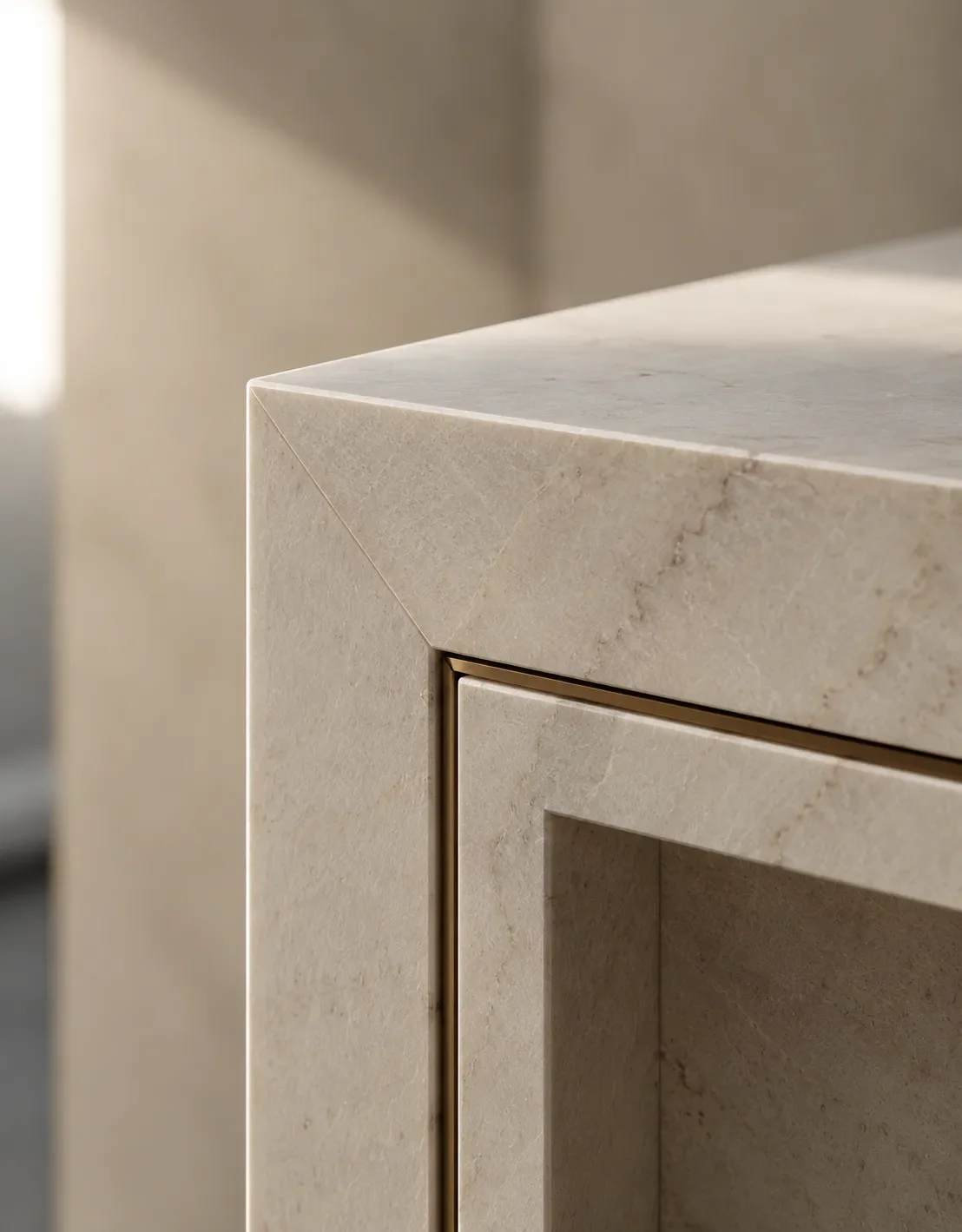
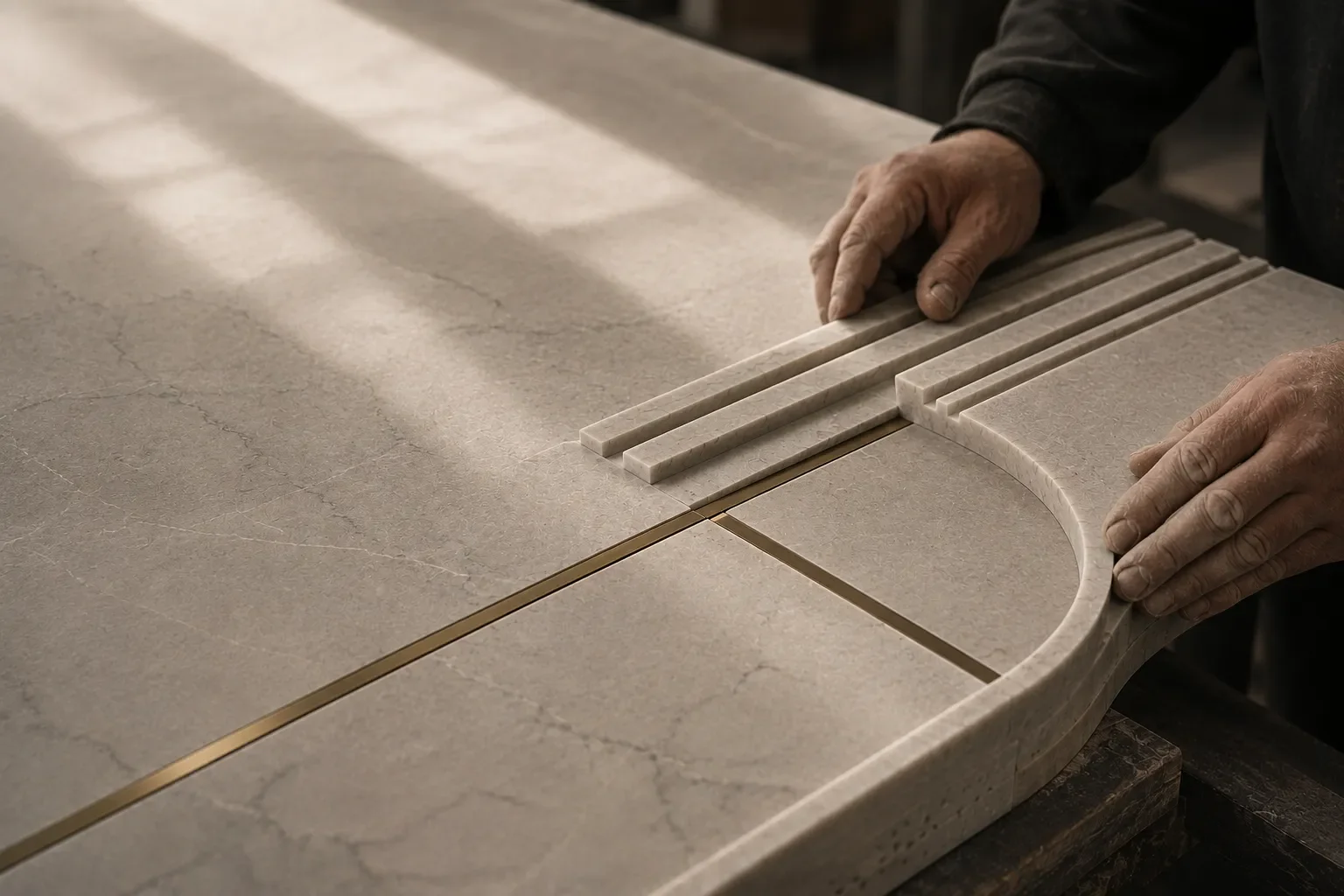
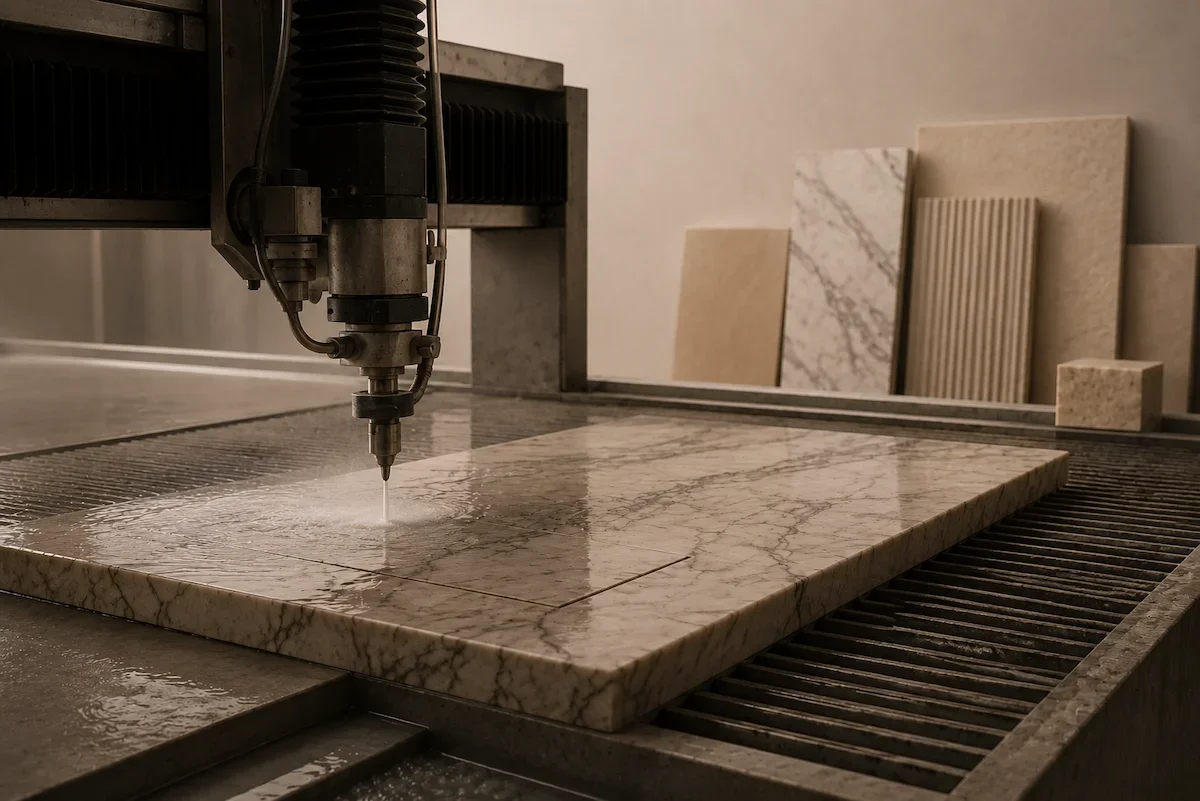
That relationship became fundamental. Some elements are extremely precise, waterjet-cut stone, brass inlays, circles, grids and polished spheres, while other areas retain the marks of cutting, carving and working the material.
I wanted the work to move between those two conditions. The geometry relates to architecture, measurement and systems of human order, whereas the irregular surfaces suggest geological processes, erosion, fragmentation and things that are much less controllable. There is something interesting to me about placing a perfectly machined object next to a piece of stone that looks as though it might have been fractured or excavated.
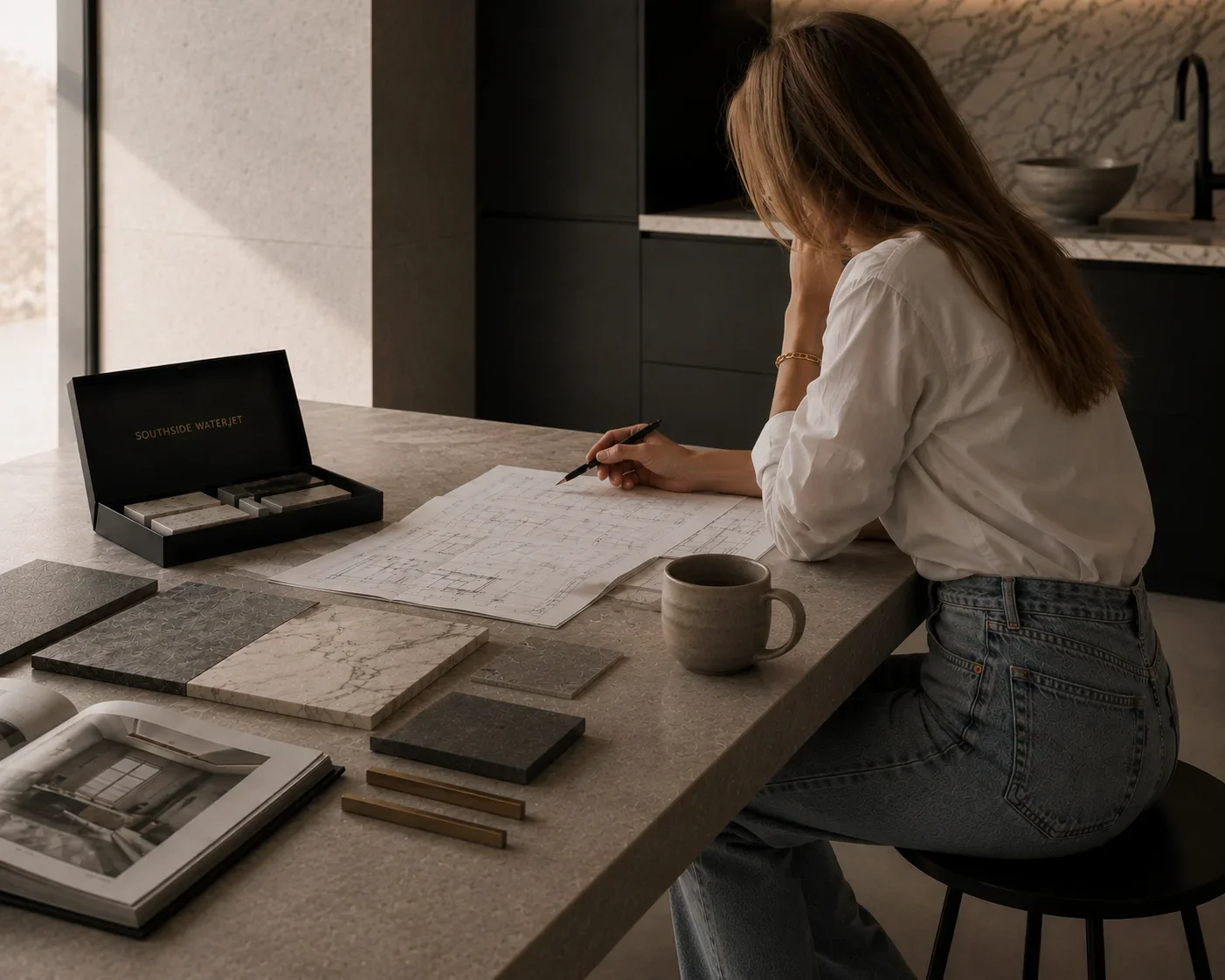
Working with Southside Waterjet and 3R Restoration was integral to bringing the design to life. The work is broken down into hundreds of individual sections and then built back together almost like building blocks, creating a composite form from many different pieces. That process is really interesting to me — how something that appears as a single, complex object is actually made up of many individual parts, processes and materials. And it isn’t just the physical components: many different people and different kinds of expertise are involved in making the work.
Complexity is reassuring to me. It resists the idea that things have to be binary or easily resolved. The work is made from many different fragments, materials and histories, and I think there is something human in that too. We are also composite — made from different experiences, histories and sometimes contradictory parts that somehow come together to form a whole.
“Complexity is reassuring to me. It resists the idea that things have to be binary or easily resolved.”
At what point in the creative process do you begin thinking about fabrication? When you're developing something of this scale, are you already considering how individual elements might ultimately be made and assembled?
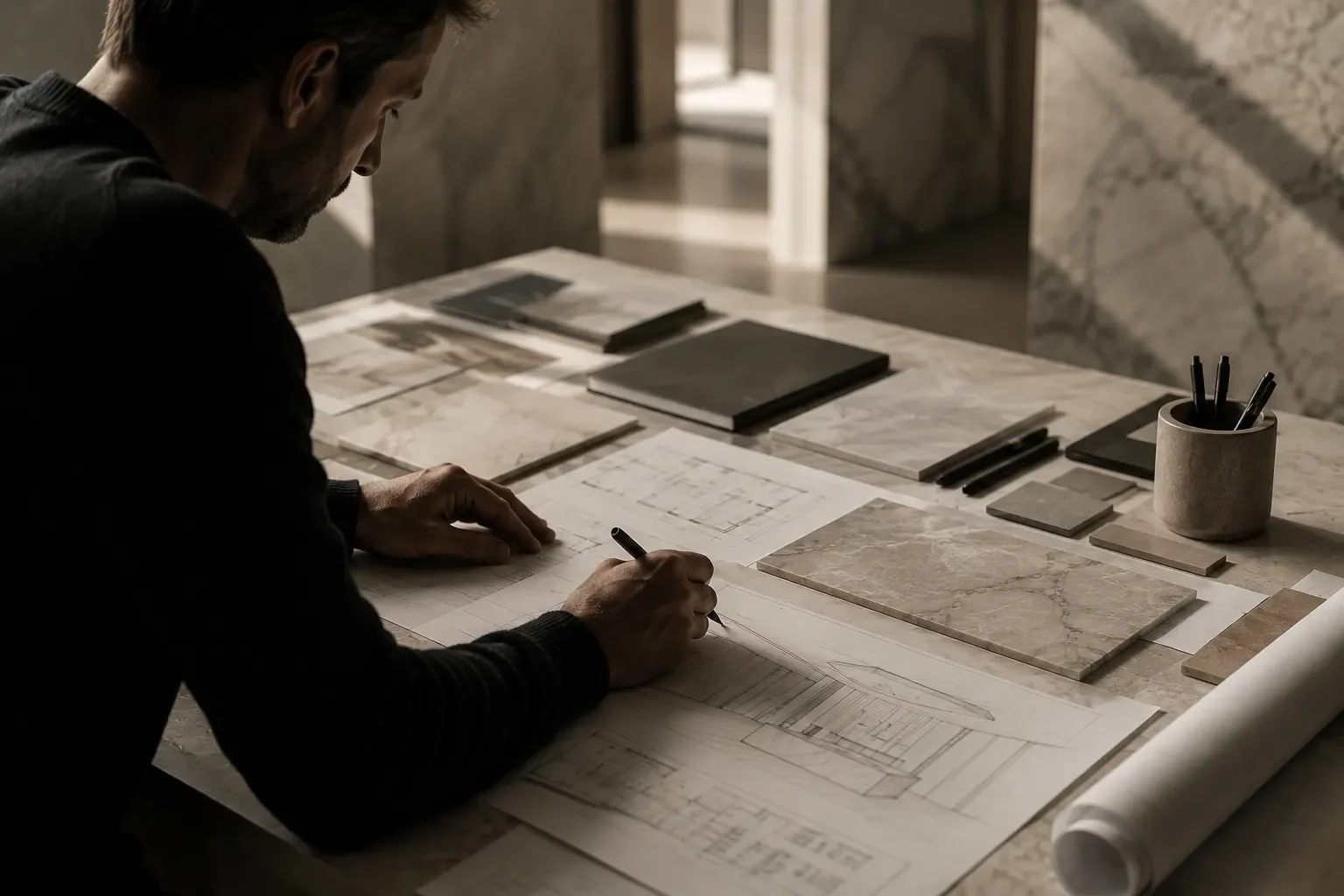
Fabrication enters the process quite early, particularly at this scale, but I try not to allow it to determine the work too quickly. Initially I’m thinking through drawings, images, models and digital compositions, but at a certain point every decision has to become physical: how thick something is, how it is cut, what supports it, how pieces meet, how tolerances work and, ultimately, how everything gets onto the building.
Working with Pete and his team has been amazing because there is a constant dialogue between the design and what is physically possible. We are always working within boundaries, material, structural, engineering and financial, and to get the best result you need to understand where those boundaries are. Sometimes those limitations actually become productive because they force you to rethink an element or find a different way of making something.
With CHRONOS, the digital design became almost a map for a much more complicated physical process. Individual components were produced using very different techniques and by different specialists, so part of developing the work was understanding how all of those processes could eventually come together as one surface. There is a continual movement back and forth between the image of the work and the reality of making it.
What is it like handing a design over to specialist fabricators and seeing something that has existed as an idea or digital artwork begin to emerge in physical material?
It’s one of my favourite parts of making work at this scale, but it’s also quite scary and nuanced because there is a lot of negotiation around what is actually possible. There is a point where something stops existing entirely within the computer or my imagination and starts to become a physical object, negotiated through materials, machines, budgets, engineering and other people’s knowledge and expertise.
Working with specialist fabricators is very collaborative. They understand their materials and processes in ways that I don’t, and those conversations can push the work somewhere unexpected. I don’t think of fabrication as simply executing a finished drawing; it is another stage in making the artwork. With CHRONOS, there was a continual process of problem-solving, experimentation and adjustment as the design encountered the realities of marble, brass and steel, and the practicalities of constructing something at this scale.
Seeing something you’ve been looking at on a screen for months suddenly appear as huge pieces of cut marble is quite extraordinary. The scale, weight, veining and texture are suddenly real, and the work begins to have a presence that you can never fully understand from a digital image. That moment when an idea becomes an object in the world is still incredibly exciting to me.
“I don’t think of fabrication as simply executing a finished drawing; it is another stage in making the artwork.”
Did the fabrication process, or the characteristics of the stone itself, influence or change any aspects of the work as it developed?
Absolutely. Stone never behaves like a completely neutral material. Every slab has its own veining, density, colour and weaknesses, and those characteristics inevitably become part of the work.
I use marble a lot because I’m drawn to its natural beauty and complexity. It has movement, history and veining running through it. I sometimes think of a slab of marble almost like a painting, but this is also where I am very much a sculptor: the pattern isn’t a depiction or representation of something — it is the structure of the material itself.
There were elements of CHRONOS that changed through fabrication because what looked right digitally needed to work differently once it had depth, weight and texture. Hand-cut and heavily worked areas sit alongside surfaces that suggest natural, fractured rock, while elsewhere the stone is cut into very precise geometric forms.
I’m drawn to sculpture because of the physical relationship you have with it — how you encounter something with your body, move towards it, around it and experience it changing from different positions. CHRONOS compresses some of that experience into a bas-relief. It is simultaneously image, surface and sculpture, and bas-relief itself has this interesting position between ancient forms of image-making and something that can feel completely contemporary.
How did it feel seeing CHRONOS installed in its entirety for the first time, after experiencing it as drawings, materials and individual components?
It was quite overwhelming. For such a long time I had experienced the work in fragments — drawings on a screen, individual slabs in workshops, cold-cast brass pieces, spheres, samples and sections of relief. Even during installation you’re concentrating on very practical things, solving problems and looking at individual details, so it’s difficult to stand back and see the whole.
There was a moment towards the end when I could finally move away from it and see the composition across the architecture. That was probably the first time I really understood the work at its actual scale. Something I had carried around in my head and worked on for such a long time was suddenly there, physically, in the middle of London. It had stopped being an image or a collection of objects and had become part of the building and the city.
There was definitely a sense of relief and pride in what we had achieved, but also something quite profound about knowing that the work is now physically embedded within the fabric of London. In a way, it has become another layer in the history of the site that inspired it.

CHRONOS is now a permanent part of the riverside architecture and will be encountered by people who may know nothing about the ideas behind it. How do you hope people experience the work over time?
I don’t think people need to know the story behind the work in order to experience it. Most importantly, I wanted the work to be accessible to as many people as possible. You shouldn’t need specialist knowledge of art, archaeology or the history of the site to find something in it. In some ways I like the idea that somebody might encounter it repeatedly without knowing exactly what it is — walking past it on their way to work, catching a reflection in one of the mirrored spheres, noticing a particular piece of stone or a detail they hadn’t seen before, and gradually developing their own relationship with it.
That’s one of the things I find exciting about public art. Once the work is there, it begins to belong to the place and to the people who encounter it. They bring their own experiences and associations to it, which are just as important as my intentions in making it. I hope there is enough complexity in CHRONOS that people can keep finding different things within it over time, but also that it can simply be enjoyed as part of the city.
What interests you about working at the intersection of art, material, craft and architecture?
I’m interested in what happens when an artwork has to exist in the world rather than within the protected space of a gallery. Architecture introduces scale, permanence, engineering, regulation, craft and public use, and all of those things become part of the process of making. I like those constraints because they force the work into dialogue with a place, with materials and with other people.
I’m also very interested in material knowledge and the relationship between contemporary technology and much older forms of making. With CHRONOS, highly precise digital drawings and waterjet cutting sit alongside carving, polishing, stone masonry and processes that have existed for centuries. That combination of ancient and contemporary ways of making feels very connected to the ideas within the work itself.
What really interests me is the point where all these different forms of knowledge meet, artist, architect, fabricator, engineer, stonemason, but also the knowledge contained within the materials themselves. Making something at this scale is necessarily collaborative. The work might begin as an idea or an image, but ultimately it has to become matter, occupy space and become part of the architecture. Hopefully it can then have a life that extends far beyond the particular circumstances in which it was made.
“The work might begin as an idea or an image, but ultimately it has to become matter, occupy space and become part of the architecture.”
Discover the making of CHRONOS
Go behind the scenes at Southside Waterjet to see how digital design, precision waterjet cutting, shaping and hand-worked stone came together during the fabrication of CHRONOS.